New Element Types
In addition to full support for all existing element types, SG-X introduces new element types that expand the modelling capabilities of SPACE GASS.
Truss Element
The truss element is a new element type introduced with the SG-X solver. Unlike standard beam and frame elements, a truss element can only resist axial force: it has no bending or shear stiffness. This makes it ideal for modelling structural members that are pinned at both ends and carry load purely in tension or compression, such as bracing members in trusses and lattice structures.
Each truss element has 2 nodes with 3 translational degrees of freedom per node. Rotational degrees of freedom are not active, reflecting the element’s inability to transmit moments.
The dedicated axial truss element is used by SG-X only. If a model containing truss members is analysed with the Paradise or Wavefront solvers, the truss members are treated as standard members with all end rotations released (pin ended members) rather than as pure axial elements, so results can differ between the solvers for these members.
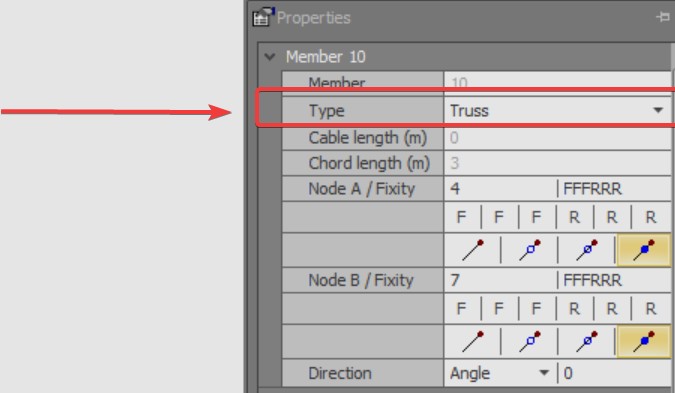
 Because a truss element carries axial force only, any member end fixities (fixed or released moment conditions) defined on the member are ignored when its Type is set to Truss. The element behaves as if pinned at both ends and transmits no moments or shears.
A series of truss elements can be chained together to model cable structures. This is in fact the approach used internally by SG-X for cable members, where each cable is subdivided into a series of truss elements as described in the Cable Members section above.
To define a truss element, set the member Type to Truss in the member properties panel, as shown below.
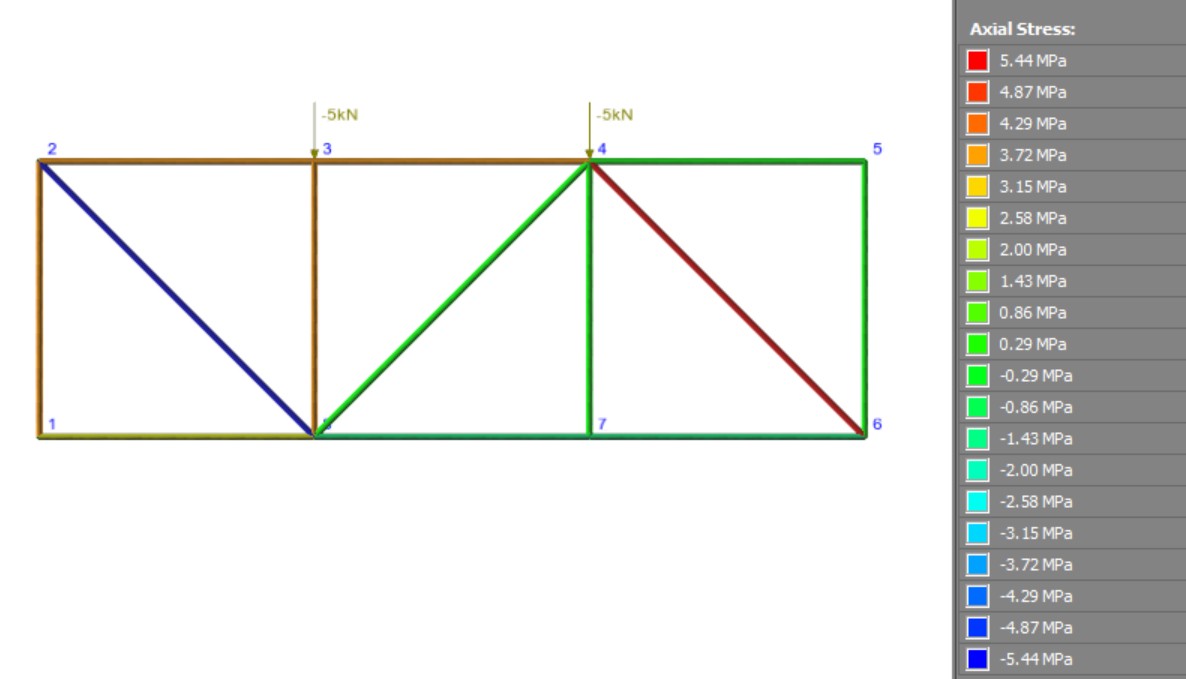
The figure below shows an example of a truss structure analysed with SG-X, with axial stress results displayed. The colour legend indicates compression (positive) and tension (negative) stresses in each member.
Pulley Element
The pulley element is another new element type introduced in SG-X. A pulley system maintains a constant tension force along the entire length of the cable that passes through the pulley: the axial force is preserved even through intermediate nodes where the cable changes direction. This behaviour models a frictionless pulley, where the cable slides freely over the pulley node. Pulley systems are supported only by the SG-X solver; the Paradise and Wavefront solvers cannot analyse models containing pulley members.
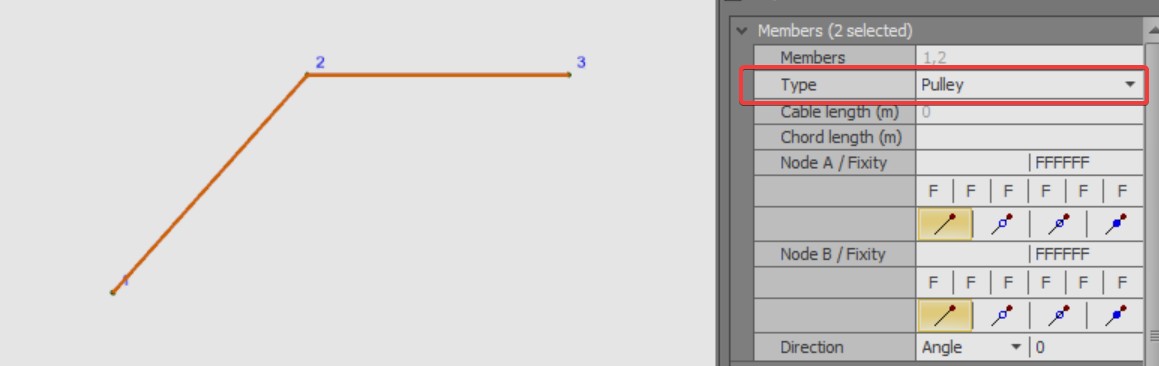
To set up a pulley system in SPACE GASS, select the members that form the pulley system and set the member Type to Pulley in the properties panel. The connected members sharing a common node will be treated as a continuous cable passing through that node, ensuring equal tension in all segments.
As with the truss element, member end fixities are ignored for members assigned to a pulley system. The pulley members act as a continuous cable in pure tension, so no moments or shears are transmitted, regardless of the end fixity settings.
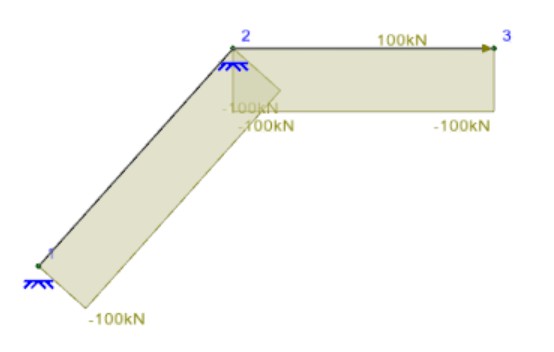
The figure below demonstrates the pulley behaviour: a 100 kN horizontal force is applied at node 3. The resulting axial force of −100 kN (tension) is preserved uniformly along both cable segments, passing through node 2 without any loss, confirming the frictionless pulley constraint.