SG-X Solver
SG-X is the latest solver engine available in SPACE GASS. It has been developed as a multi-threaded C++ solver, engineered for speed and reliability on modern multicore hardware.
Key Characteristics
- Multithreaded architecture. SG-X takes full advantage of modern multicore processors by distributing the computational workload across multiple threads. This results in dramatically faster solve times, particularly for large models with many degrees of freedom.
- Native C++ implementation. The solver is implemented entirely in C++, providing low level control over memory management and numerical operations for maximum computational efficiency.
- Superior performance. SG-X is significantly faster and more reliable compared with the Wavefront and Paradise solvers, especially for large and complex structural models.
- Full feature compatibility. SG-X covers all functionality of the previous solvers. Every element type and analysis method available in SPACE GASS is fully supported by SG-X.
- Default solver. SG-X is now the default solver in SPACE GASS, reflecting its maturity and reliability. Users can still switch to the Wavefront or Paradise solvers if desired.
Performance
One of the primary motivations for developing SG-X was to deliver a step change in solver performance. The multithreaded C++ architecture of SG-X provides significant advantages over the Wavefront and Paradise solvers.
Multithreading
Modern computers typically feature processors with multiple cores. SG-X is designed to utilise all available cores during the solution process, distributing the matrix assembly and factorisation workload across threads. This means that users with modern hardware will experience substantially shorter analysis times without any additional configuration.
 The Paradise solver does support multithreading for models that do not contain shell elements. However, a known bottleneck exists in Paradise when shell elements are present: the assembly of element stiffness matrices into the global stiffness matrix is performed under a single thread, significantly limiting performance. SG-X eliminates this bottleneck by fully parallelising all stages of the solution process, including stiffness matrix assembly, regardless of the element types in the model.
Observed Performance Gains
In many internal tests, SG-X has reduced analysis times from hours to just a few minutes.
The speed gains are particularly significant and noticeable in the following scenarios:
- Models containing plate elements
- Non-linear analysis
- Buckling analysis
- Dynamic frequency analysis
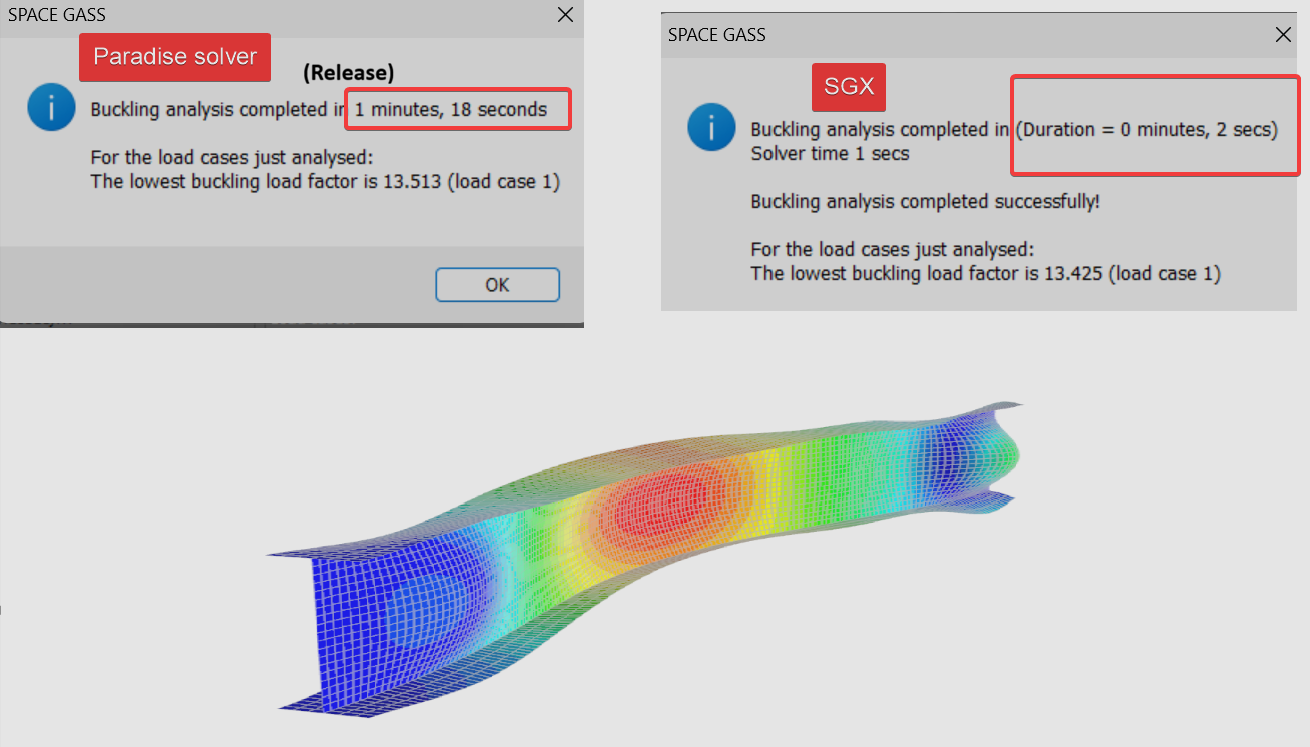
The figure below illustrates a typical speed comparison for a buckling analysis of a model with shell elements. The Paradise solver completed the analysis in 1 minute and 18 seconds, whereas SG-X completed the same analysis in just 2 seconds.
Memory Efficiency
SG-X employs efficient memory management strategies that allow it to handle very large models with millions of degrees of freedom. The solver automatically adjusts its memory allocation according to the size of the job, utilising both RAM and disk storage as needed.